

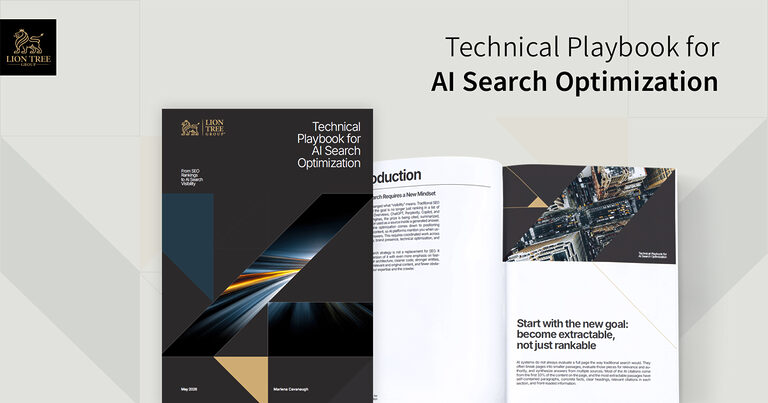
AI search has changed what “visibility” means. Traditional SEO still matters, but the goal is no longer just ranking in a list of blue links. In AI Overviews, ChatGPT, Perplexity, Copilot, and other answer engines, the prize is being cited, summarized, recommended, or used as a source inside a generated answer. Generative engine optimization comes down to positioning your brand and content, so AI platforms mention you when users search for answers. This requires coordinated work across content strategy, brand presence, technical optimization, and reputation.
The best AI-search strategy is not a replacement for SEO. It is an adapted version of it with even more emphasis on faster pages, clearer architecture, cleaner code, stronger entities, better citations, relevant and original content, and fewer obstacles between your expertise and the crawler.
1. Start with the new goal: become extractable, not just rankable
AI systems do not always evaluate a full page the way traditional search would. They often break pages into smaller passages, evaluate those pieces for relevance and authority, and synthesize answers from multiple sources. Most of the AI citations come from the first 33% of the content on the page, and the most extractable passages have self-contained paragraphs, concrete facts, clear headings, relevant citations in each section, and front-loaded information.
2. Build a logical site architecture that AI crawlers can understand
A clear site structure helps LLMs understand topical relationships and identify authoritative URLs. Logical hierarchies, topic clusters, consistent URL structures, canonicalization, shallow crawl path, and controlled parameters so crawlers can understand which pages matter and how they relate to one another.
AI systems benefit from semantic clarity. When a website has a messy architecture, the model may still find pages, but it may struggle to understand which page is the best source for a specific topic.
3. Make critical content available in raw HTML
This is one of the most important technical points for AI search. The majority of the AI crawlers rely on the HTML response and may not execute JavaScript the way Googlebot can. Ensuring that the most significant text and links are available directly in the initial HTML rather than being injected after page load.
If your page looks complete to users but the core content only appears after JavaScript renders, some AI crawlers may not see it. Tabs, accordions, filters, and interactive modules are fine for UX, but the underlying important content should still be present in crawlable HTML.
4. Use headings, paragraphs, lists, and tables for “snippability”
AI search rewards content that is easy to parse. Structured writing and formatting are not optional in the age of generative AI: headings, paragraphs, lists, order, clarity, and consistency all influence what LLMs can extract and surface.
Aligning the title, meta description, and H1; using descriptive H2/H3 headings; writing self-contained Q&A blocks; using short lists, steps, and comparison tables where useful; and adding JSON-LD schema that matches the page type.
A strong AI-friendly content layout looks like this:
Page title: specific and intent-matched.
Intro: direct answer or summary within the first 100–150 words.
H2 sections: one core idea per section.
Paragraphs: short, self-contained, and specific.
Lists: used for steps, criteria, pros/cons, and recommendations.
Tables: used for comparisons, pricing, features, specs, and decision criteria.
FAQs: written in natural language, matching real user questions.
Conclusion: summarizes the decision, next step, or key takeaway.
Avoid long walls of text, vague claims, hidden key content, image-only information, and PDFs as the only source for core information.
5. Put the answer near the top
AI systems and users both benefit when a page gets to the point quickly. LLMs look for a defined topic scope at the top of a page instead of forcing the model or user to scroll through long brand storytelling before reaching the substance.
For every important page, include a direct answer block near the top:
For a service page: “We help [audience] solve [problem] using [method], with [proof point].”
For a product page: “This product is best for [use case], includes [key features], and differs from alternatives by [differentiator].”
For a blog post: “The best way to optimize for AI search is to make your content crawlable, extractable, authoritative, and consistently mentioned across trusted sources.”
For a comparison page: “Choose X if you need [criteria]. Choose Y if you need [criteria].”
This helps AI systems identify the page’s purpose immediately.
6. Use schema, but do not rely on schema alone
Structured data helps clarify the page type, entities, dates, authors, products, reviews, FAQs, events, and organization details. It should match the visible content on the page. JSON-LD schema that matches the page type, but it also emphasizes that structure, clarity, and “snippability” are what improve eligibility for AI answers.
Useful schema types include:
- Organization.
- Person.
- Article or BlogPosting.
- Product.
- Review
- FAQPage, where appropriate.
- HowTo, where appropriate.
- LocalBusiness
- BreadcrumbList
- VideoObject.
It is recommended to use the datePublished and dateModified schema to indicate when content was created and updated.
Schema should reinforce what the page already says. It should not be used to stuff claims, fake reviews, or mark up content that users cannot see.
7. Manage robots.txt for AI crawlers
Robots.txt is now a strategic AI-search file, not just a traditional SEO file. Robots.txt still plays a key role in managing crawl access, including telling crawlers which areas they can or cannot access and pointing them to XML sitemaps.
Site owners can allow or block specific AI crawlers such as GPTBot, ClaudeBot, or PerplexityBot, and can use different rules for different bots.
A simple AI-aware robots.txt strategy:
User-agent: *
Disallow: /admin/
Disallow: /cart/
Disallow: /checkout/
Disallow: /internal-search/
Sitemap: https://www.example.com/sitemap.xml
User-agent: GPTBot
Allow: /blog/
Allow: /resources/
Allow: /guides/
Disallow: /private/
Sitemap: https://www.example.com/sitemap.xml
Do not accidentally block your best content. Many sites disallow entire directories without realizing that important articles, PDFs, product data, or resource hubs live inside those folders.
8. Maintain an XML sitemap
Your XML sitemap includes e the URLs you want crawlers to discover, index, and potentially use in AI responses. Exclude low-value, duplicate, or non-indexable URLs, using <lastmod> tags to signal freshness, automating sitemap updates, and referencing the sitemap in robots.txt.
Good sitemap hygiene includes:
- Only canonical, indexable URLs.
- No redirects.
- No 404s.
- No internal-search pages.
- No thank-you pages.
- No parameter duplicates.
- Accurate <lastmod> dates.
Separate sitemaps for large sections, such as blog, products, videos, and images.
For AI search, your sitemap is not just an indexation aid. It is a map of what you want machines to consider authoritative.
9. Improve speed and server reliability
AI crawlers can only process what loads successfully. Slow or failed pages give crawlers nothing to read or index, and fast, stable performance can encourage more frequent crawl visits.
Prioritize:
- Fast server response times.
- Stable hosting.
- Compressed images.
- Lazy loading for noncritical media.
- Minimal render-blocking scripts.
- CDN usage for global audiences.
- Clean caching rules.
- Core Web Vitals improvements.
- Reduced layout shift.
Fast pages help humans, traditional search engines, and AI crawlers. Speed is not a separate AI-search tactic; it is the delivery layer for every other optimization.
10. Keep content fresh where freshness matters
AI systems often prefer current information when the topic is time-sensitive. Research shows that a large share of AI bot log hits targeted content published or updated within the past year, but understand that freshness depends heavily on the topic and industry. Evergreen how-to content may remain useful for years, while finance, legal, health, technology, and product information often need frequent updates.
Update content when:
- Facts, prices, laws, features, or policies change.
- Competitors release new products.
- New research becomes available.
- Screenshots or UI steps are outdated.
- Statistics are older than the industry norm.
- Search intent has shifted.
The article still ranks, but no longer answers the current question.
Show both published and updated dates where helpful, and ensure the structured data matches reality.